
James V. Hardt, Ph.D.
Abstract
The recent availability of sophisticated computerized EEG analysis equipment, has popularized “brain mapping”, bringing many varieties of colorful types of displays, each one capable [with varying degrees of resolution] of imaging happy brains, depressed brains, active brains, resting brains, etc. In spite of their many variations, all of these “brain mapping” techniques are alike in that they are purely descriptive and do not have a predictive or prescriptive capability. The current mapping techniques can describe a happy brain or a depressed brain, but they can not predict or prescribe what brain parameters to change, or what sequence of changes to make, or in what direction to make the changes in order for the person to change from a feeling of depressed to happy, or from sleepy to vigor, or from confused to clear thinking. As a consequence, much EEG feedback is misguided, or worse, unguided.
This deficiency is remedied with a new Brain Activity Mapping And Training (BAMAT) method. Twenty one different psychological mood states were assessed with published mood scales (MAACL, Clyde, POMS) before, during, and after each of the 7 consecutive days of the Biocybernaut Institute introductory alpha feedback training, in which 17 right handed non-meditators (men and women) had 8 channel EEGs (O1, O2, C3, C4, T3, T4, F3, F4) recorded while each channel was filtered into 8 spectral sub-bands (delta, slow theta, fast theta, slow third of alpha, broadband alpha, fast third of alpha, slow beta, broad-band beta) while each person had 4 simultaneous channels of EEG integrated amplitude feedback on broad-band alpha from O1, O2, C3, and C4.
Auditory feedback was from 4 spatially separated speakers, each of which used different tonal pitches, optimized to minimize alpha blocking to tone onset. At regular 2 minute intervals, the auditory feedback stopped for 8 seconds, during which time digital displays were illuminated to show trainees their integrated amplitude alpha scores at each of the 4 feedback sites: O1, O2, C3, C4.
The 64 EEG variables (8 channels X 8 filters) were analyzed to produce mean, maximum, and minimum scores on each variable, which were convolved with the mood scale variables in novel ways to minimize individual error variance and maximize the predictive power of the resultant Brain Amplitude Maps. The resultant partial differential psychophysiological surfaces reveal recurring three dimensional patterns, which are imaged in the predictive Brain Activity Maps for different mood states. These recurring 3-D patterns reveal surprising underlying similarities between certain specific psychological states known as specific moods. Striking visual similarities are immediately apparent between maps from moods we consider similar.
Important applications to mental health and peak performance are readily suggested, since these maps show, in very detailed ways, how to change brain activity to achieve any desired type of mind activity or mind-related activity. This includes skills, abilities, moods, feelings, experiences, mental and personality traits, behavioral characteristics, as well as any aspect of any process in the mind or body which one wishes to alter. The implications of having such detailed prescriptive maps to guide and direct EEG feedback training challenge our current powers of imagination. Fortunately this BAMAT training methodology can be used to improve our imaginative abilities, as well as our abilities to understand and to integrate the vast cultural changes which this methodology will usher in.
Full text of the presentation
Text of a presentation to the I.O.P. Symposium on “Altered States of Consciousness”, 7th International Congress of the International Organization of Psychophysiology, Porto Carras, Greece, Sunday, October 1, 1994.
In this Symposium on Altered States of Consciousness, Chaired by Dr. Bechtereva, I am the last speaker, and I should like to use this role as the final speaker to discuss and weave together some themes from the other guest speakers. Hopefully, this summary and synthesis will serve as a preamble to my own comments on Methods For Mapping And Altering Human Mind States. Dr. Bechtereva's address on the opening night of this 7th International Congress defined the scope of our challenge and our opportunity as Psychophysiologists. Speaking in her role as 1st Vice President of the International Organization of Psychophysiology (I.O.P.) she urged us to discover, to invent, and to develop effective methodologies for extracting information from the psychophysiological data of the brain. She also noted that there exist unhealthy minds and unhealthy mind states, which cause so many problems to individuals, societies, and the planet as an ecological whole. She said that we need to enlist the help of the healthy minds, which will give us then the hope of a better world. Using the Differential Psychophysiological Surfaces, about which I shall soon speak, it is now possible to create a new class of mind training methods, which can be implemented with Neurofeedback training technology. This new class of mind training methods enables people to retrain complex, large scale patterns in their own brain activity. This produces remarkable transformations from unhealthy to healthy brain activity, which brings about transformations from unhealthy mind states to healthy mind states, and this, in turn, offers an even greater hope than Dr. Bechtereva's address called for. With this new technology the already healthy minds can become more creative and can develop latent gifts of the mind. Also with this new technology the unhealthy minds can learn how to eliminate their brain wave patterns of anger, hostility, anxiety, depression, and unhappiness, which eliminates the person's experience of anger, hostility, anxiety, depression, and unhappiness. Using this same process people can learn how to generate the brain wave patterns of positivity, friendliness, vigor, and clear thinking, which then gives them the experiences of positivity, friendliness, vigor, and clear thinking. In this process the good minds become better, and the bad minds become good. Imagine the difference this will make to our world.
The first speaker today was Dr. Stanley Krippner, who spoke on "Altered States of Consciousness in the Post-modern Age." Dr. Krippner's discussion of Multiple Personality Disorder (MPD) is very important to Dr. Bechtereva's call for the help of the healthy minds, and is intimately connected with my own work with Neurofeedback training to transform unhealthy minds into healthy minds. Therefore I wish to review and extend some of Dr. Krippner's comments. He spoke about the profound EEG changes which occur spontaneously as one personality switches into another personality, and about the perceptual differences and allergy differences between two or more personalities sharing the same body. He cited how each of the different female personalities in a female body with MPD could each have its own menstrual cycle every month. All of this flies in the face of contemporary established wisdom on the biological basis of perception, immunology, and reproductive ability, to mention just a few fields in desperate need of revisions to incorporate the new and expanding knowledge. This challenge posed by MPD to the established medical, physiological, and psychophysiological thinking is our invitation and our obligation to reformulate a new understanding of the vast role of mind in human behavior, and even in human physiological processes.
An important key to correctly formulating this new Multi-disciplinary understanding is the profound EEG changes which occur when one personality shifts into another personality. With the rapidly expanding technology of Neurofeedback, we can teach people how to produce such shifts in their own EEGs on a voluntary basis. Extensive research in my laboratories at several Universities and Institutes has demonstrated that learned, voluntarily produced changes in a person's EEG is followed by profound changes in their personality. High Anxiety people have transformed themselves into low Anxiety people by learning to produce the appropriate new patterns. The newly learned patterns are experienced as pleasant, useful, and adaptive, and they continue to persist years later, even without further training. We always train people in bi-directional control, and when people successfully enhance the pattern associated with Anxiety, they become more anxious, and in the process, they learn what brain waves to avoid producing. This knowledge is an important complement to the knowledge of what brain wave patterns are desirable and how they can be most effectively enhanced.
The process involving changes in and changes in personality is symmetrical, in that the obvious changes in personality seen in MPD are associated with profound changes in the EEG, and, on the other hand, learned changes in the EEG bring about profound changes in the personality. Somewhere in this symmetry is a causal agent, and I can see in my laboratory that the EEG is, at one level, the causal agent. To change your EEG is to change your personality, to change your perceptions, to change your biochemistry, indeed to change your whole awareness. Welcome to the I.O.P. Symposium on Altered States of Consciousness. Viewed with this larger vision, Neurofeedback is indeed a technology of awesome power and tremendous promise. Which personality you have will be seen to be a function of what EEG pattern you are currently producing. Just as a computer behaves differently when different operating systems are loaded [e.g. DOS, Windows, UNIX, etc.], so do people behave [and believe] differently when they have different EEG "programs" loaded in their brains. Of people we can now say, "Changing their EEG patterns changes their personalities, their beliefs, and their performance in life."
In Olden Times people believed the world was flat. This belief limited exploration, commerce, and knowledge. Christopher Columbus and other courageous seafaring explorers braved political opposition, jealous colleagues, and entrenched economic, and theological elites to venture forth upon the Ocean Sea, to shatter this false belief and to open up a new world. In the process there arose the knowledge which has led to new human societies and to our current planetary perspective.
In Olden Times people believed EEG was an autonomic function and that personality traits were stable over the adult life span. Courageous psychophysiological explorers have braved similar opposition, and in the process have shattered these false beliefs, in the process of opening up a new inner world, and revealing a new phenomenological reality. In this process knowledge is arising which is causing us to re-evaluate our own natures and to expand our expectations of our own possibilities. The Science of Psychophysiology is well positioned to generate and to integrate this new knowledge which will lead to both fundamental changes in our understanding of who we are, as well as to fundamental changes in who we are.
By learning to consciously change their brain activity, people can learn how to regulate and to change almost any process in their minds and bodies. A person with such capabilities is far outside the range of cultural norms. The appearance of such people, even in small numbers, will rapidly redefine our cultural beliefs about what is possible and desirable, and what is normal. A culture comprised of consciously self-regulating people will bear little resemblance to any culture as we know it, and it is beyond our current abilities to imagine.
The future was also on Dr. Spivak's mind, when, at the end of Dr. Krippner's talk, Dr. Dimitri Spivak asked him about the future of work with altered states. Dr. Krippner replied that a better understanding of altered states is the key to peak performance states, including athletic peak performance states, which top athletes experience and describe in their slang as "the Zone". But even the top athletes are infrequent visitors in "the Zone", and their arrival in "the Zone" cannot be planned or voluntarily initiated, because they lack experience with Neurofeedback techniques for producing the EEG patterns associated with "the Zone". Dr. Krippner's prophetic vision about the future role of altered states in facilitating the tailoring and the timing of peak performance will be brought to fruition much sooner if we have accurate and detailed psychophysiological characterizations of "the Zone", and of other states of mind-giftedness and of peak mental and physical performance. Using the technology of Neurofeedback training, the basic psychophysiological knowledge of useful and desirable altered states can be easily and quickly turned into applied knowledge and effective training programs. Anyone who is engaged in the pursuit of excellence in any field of human endeavor will benefit from direct training of the EEG patterns associated with the desired skill, or ability, or mental or physical characteristics.
When Dr. Spivak addressed the group in his own talk, we saw his careful characterization of the different types of altered states. This excellent set of descriptive distinctions will serve as a highly useful background to the careful EEG characterizations of the various altered states. Looking for patterns shared between the EEGs of different altered states will be easier for someone using Dr. Spivak's distinctions and categories. Altered states known to be similar may have EEG patterns in common Similarly, the discovery of unsuspected commonalities in the EEG patterns of classes of altered states will suggest unsuspected similarities and differences among and between Dr. Spivak's categories. Thus it is clear that these two methods, together, cooperatively support the generation of new knowledge and deeper understanding about the meaning and utility of altered states and their associated EEG patterns. With the expanding Neurofeedback training methods, we finally have a reliable probe for exploring and comparing different altered states. Researcher-Explorers can systematically train themselves how to enter the different desired altered states of awareness through Neurofeedback training methods, and they can then bring back their own subjective reports to describe and to compare and contrast the various altered states. And the Neurofeedback technology will provide the objective data from these voyages of inner exploration to augment the subjective reports of the Inner-Nauts. This combination of the Psycho- and the Physio- logical data from altered states will create the Psychophysiological understanding of altered states including how to get into them, how to get out of them, how they compare to other states, how easy or difficult they are to train, and to what higher purposes they may be beneficially applied.
The talk by Dr. Smith on the use of the chemical agent Phenytoin in treating prisoners shows a drug treatment alternative to Neurofeedback treatments. It would be interesting to measure the neuroelectric changes associated with Phenytoin treatment and then to provide Neurofeedback training to assist people in voluntarily producing those same changes, rather than inducing them in the prisoners with drug treatments. If the magnitude of the benefits are comparable with Neurofeedback training, there may be other benefits of Neurofeedback therapy over drug treatments. Neurofeedback-derived improvements may be much longer lasting than drug treatments, because they represent a learned mind state for the trainee, rather than some transitory, externally induced, biochemical/pharmacological treatment. For example, pilot studies of EEG theta feedback in U.S. prison populations have show reductions of recidivism up to 90%. We can also compare Neurofeedback treatments and drug treatments for anxiety. The 4 leading anti-anxiety drugs have combined annual sales in America exceeding $500,000,000. Anxious people taking these drugs experience some relief of anxiety, but some also have adverse drug side effects, and they must continue taking the drugs. Of course this is good for the profits of the drug companies. Alternatively, if anxious people use Neurofeedback to learn how to change their EEG patterns into the low anxiety pattern, they become low anxiety people, and they do not need to continue Neurofeedback training, and they do not need to take anti-anxiety drugs, and they do not have adverse side effects. Neurofeedback is a qualitatively different alternative to drug treatments, which puts the means of healing into the patients' own hands, or more accurately, into the patients' own minds. Then the patients become their own healers, and they heal and maintain themselves in wellness. There is also another connection between Dr. Smith's work, and the work I will show you today, which is our shared used of the Profile of Mood States [POMS] as a psychological instrument to quantify the changes in mind states of our research subjects. We can be sure that we are both talking about the same kinds of changes in mind states and awareness when we are both using the same test instruments. The Differential Psychophysiological Surfaces I will show you were derived using the POMS, and two other mood scales, to quantify Psychological State. The other two test instruments were the Multiple Affect Adjective Check List [MAACL] and the Clyde Mood Scale. Before describing these Brain Activity Maps which feature the Differential Psychophysiological Surfaces created by convolving changes in these mood scales with changes in EEG measures, it is essential to include an extremely important theme from Dr. Hans Liljenstrom's presentation.
In his address, Dr. Liljenstrom spoke persuasively about how a greater complexity of the brain affords the possibility of a higher degree of consciousness. One of the most compelling confirmations of Dr. Liljenstrom's declaration comes from comparative Neurophysiology. Comparing brain cell densities of different animal species and graphing these density values on an X-Y grid as a function of the measured IQ of each species results in a scatterplot with an upward slope,- a clear positive correlation. Higher neuronal packing density is associated with higher measured IQ. It is obvious that the more tightly packed are the neurons, the greater is the number of other neurons can be reached by neural processes, such as dendrites, extending out a fixed distance from any particular neuron. It is also clear that: The greater the number of other neurons to which each neuron is connected, the higher is the complexity of the neural network thus formed. Thus we have a direct confirmation of Dr. Liljenstrom's statement that greater complexity of a brain affords the possibility of a higher degree of consciousness, because here we are seeing higher measured IQ's in brains that are more complex [i.e. greater neuronal packing density].
Some people are aware of one striking apparent counter example to this positive association between IQ and Neuronal Density. This is the case of dolphins. Dolphins have an average neuronal density about 1.8 times greater than humans, and yet measured dolphin IQs are well below that of humans. This apparent contradiction is resolved when we do careful histological studies of dolphin brains. Then we find that while dolphin neurons are in fact packed more closely together, offering the potential for much higher IQ than humans, dolphins unfortunately fail to actualize this potential because their neurons are deficient in arborization of the dendrites. To say this is "unfortunate" is to invoke the values of a human cultural perspective. What we can say objectively is that with fewer connective processes extending out from each neuron, the latent complexity potential of the dolphin neural networks remains undeveloped. As a result, their IQ's remain lower than human IQ's, and well below the potential suggested by the dolphin neuronal density. So we see, upon closer analysis, that Dr. Liljenstrom's association of higher brain complexity with higher orders of consciousness is also supported by the dolphin data. We see also that while dolphins have the potential for a much greater brain complexity than humans and, correspondingly, a much greater potential consciousness than humans, this potential remains only latent and undeveloped. We may speculate that since dolphins are so perfectly adapted to their environments that they have not had the selection pressure to more fully develop this latent potential. We may compare dolphins' evolutionary selection pressure with the selection pressure on hominid evolution. Hominids had a multiplicity of large predators, and climatic adversities including floods, droughts, winters, summers, and of course ice ages, none of which impacted recent dolphin evolution significantly. Perhaps recent selection pressures on dolphins from the large scale killing of dolphins for human food, and from the world's tuna fishing fleets with their nets, which unintentionally kill dolphins, will cause additional dendrites to sprout in dolphin brains. This development might soon make dolphins a force to be reckoned with on the planet, with humans becoming only the second most intelligent Terran species. The time for this dolphin brain evolution would be measured in many dolphin generations. Just how many generations we might wisely begin to assess.
Significant and measurable brain evolution in human brains has been occurring rapidly over time spans as short as 20 generations. As revealed by a landmark study reported in Science, the brain volumes of modern Europeans average 1 cubic centimeter larger than their recent ancestors of the 1500's. Human brains have high neuronal packing densities and high complexity in their neuronal interconnection networks, and now we are becoming aware of size increases occurring in human brains at phenomenal rates, compared with evolutionary time scales. The most likely application of increased brain volume is to provide greater complexity of the nervous system, with corresponding increases in the degree of consciousness, which is in direct agreement with Dr. Liljenstrom's presentation.
As fast as Mother Nature is increasing the size and the complexity of the human brain, there is another agent doing the same thing, but thousands of times faster. This agent is human consciousness applied to and through electronic Neurofeedback technology. For millions of years of hominid evolution, up until 1962 AD, all human neural processing took place in carbon based cells using bio-chemo-electric processes. In 1962 Kamiya created the first EEG feedback circuit using complex silicon-chip-based circuits embodied in electronic technology to interface with the brain's electrical processing activity. In the resulting first use of Neurofeedback, the brain was provided with feedback on its own activity by the addition of circuitry located outside the brain. Neurofeedback is truly a fabled "missing link," because the brain is impoverished in feedback about itself, even while it is richly provided with feedback about the activities in and of the body. The brain's existing feedback circuits are all biological, i.e. carbon-based circuits, which give the brain feedback about a multiplicity of processes in the body. But almost totally absent from the brain are any feedback circuits to bring into consciousness any of the brain's own activity. We know from cybernetic theory that feedback profoundly changes any system to which it is added. We are now in a position to give to the brain abundant feedback about itself, and we know this will profoundly change brain functions, brain structures, and even our the definition of what is "our brain."
We no longer need to wait for Mother Nature to provide us, transgenerationally, with additional brain circuitry, although that is happening ongoingly. We can now grow our extra brain circuitry on silicon chips and then interface these new silicon-based circuits with the carbon-based circuits of the brain's neuronal networks. In the process we can rapidly expand the complexity of our brains, and we can do so within generations rather than across generations. We can continually devise new and more complex extra-cranial neural circuitry for ourselves. If we keep in mind Dr. Liljenstrom's explanation of the relationship between brain complexity and degree of consciousness, we will quickly realize that each human brain alive today can be vastly expanded in complexity and in degree of consciousness by the addition of neuro-feedback connections using silicon-based microcircuits and their enormous computational power. In this process we are transforming our minds and our brains as we are becoming this planet's first hybrid beings, whose consciousness results partly from complex neural processes in carbon-based circuitry and also partly from complex computational processes in silicon-based micro circuitry.
As we take this vast evolutionary leap of becoming hybrid beings, we blur the distinction between organic and inorganic worlds, as our minds learn how to create noesis out of the enhanced functioning, and the integrated functioning of both organic and inorganic computational platforms. Noesis is comprehension or knowingness produced by the operation of the intellect alone. In this context the noesis or new comprehension and new knowingness would be produced by the integrated functioning of both organic and inorganic computational platforms,- brain and microchips functioning as one. In this new noetic alliance between the organic and inorganic worlds, even our definition of our brain will change. Our brains will only provide us with these new comprehensions and new apprehensions when suitably interfaced with the new silicon-based micro circuits; and these silicon circuits can evolve in complexity with fantastic speed. We will come to understand our brains as partly biological processing capacity, and partly inorganic processing capacity, both linked together to achieve higher orders of complexity. The rapid evolution of our ever more advanced awareness is assured by the phenomenally rapid evolution of complexity in silicon circuitry, which can be interfaced with our brains' carbon-based circuitry through Neurofeedback methods.
To optimize our recently recognized evolutionary potential, we must do more than develop faster and more complex neurofeedback circuitry. We must also develop new knowledge of how best to interface brains and silicon microcircuits. Of all the Sciences, Psychophysiology is most ideally positioned to generate this new knowledge of how to interface brains and electronic microcircuits. Psychophysiology and Psychophysiologists can lead this evolutionary process and the resulting revolution in consciousness, if we begin at once and proceed with wisdom, self honesty, self responsibility, and love. There is an evolutionary imperative operating here, which compels the evolution of form toward greater complexity and higher orders of functionality. If we as Psychophysiologists fail to respond to this evolutionary imperative, the process will still continue, but under the direction of the Medical and Computer Science professionals, whose disciplines lack the wisdom of the larger integrated vision of embodied minds, which is the natural vision of Psychophysiology. When these evolutionary trends are viewed in light of Dr. Liljenstrom's explanation of the relationship between brain complexity and degree of consciousness, we see that the rate of evolution of human consciousness is in a transition to superluminal velocities. The dolphins will have to sprout dendrites very rapidly to avoid falling further behind.
The results of Neurofeedback therapy have already shown that increasing the degree of a brain's consciousness, through feedback, has a healing and transformative effect. The brain activity patterns associated with the experiences of Anger and Hostility can be voluntarily altered with Neurofeedback training and can be replaced by the brain activity patterns associated with the experiences of Friendliness and Vigor. Similarly the EEG patterns and the experiences of Confusion and Bewilderment can be transformed into the EEG patterns and the experiences of Clear Thinking and increased Creativity. Careful laboratory measurements with personality tests and mood scales, together with personal reports, case studies, and objective, observable changes in life circumstances, have documented these statistically significant and repeatable therapeutic outcomes of the application of Neurofeedback training to human brains. By extending this work, we can achieve and even surpass the hopes of Dr. Bechtereva that we must enlist the help of the healthy brains to have the hope of a better future. We can now give the owners of the unhealthy brains the Neurofeedback means for transforming themselves from destructive into constructive agents in their own lives and in the many collective enterprises of humanity.
One of these exciting collective enterprises is constructing the Science of Psychophysiology,
and I will now describe how the data and techniques of Neurofeedback training can be processed and analyzed in Differential Psychophysiological Surfaces so as to go beyond therapy and peak performance to provide insights into the Deepest Quest of Psychophysiology.
The Deepest Quest of Psychophysiology is to find the function " f "

Where "f" is a perfectly general base function relating Psychological variables or "mind" variables [ Ψ ] to their relevant underlying Physiological variables [ Φ ]. In the history of the quest for understanding of this base function, there have been some heroic efforts and some spectacular failures. For example, in 1960 there was a monumental study done in Spain with 10,000 human subjects all 18 years of age. This study looked at the Ψ base function of Psychological variables using personality tests, and the Φ base function of brain Physiology using EEG recordings, which were read and rated by clinical Electroencephalographers. The massive resulting data sets were correlated to search for f(Ψ,Φ) in the relationships between the base functions of Psychological variables and the base functions of Physiological variables. Sadly, there were few significant correlations, which is unfortunately characteristic of the history of the search for f(Ψ,Φ). Whenever Psychophysiological investigators collect data on the base functions of Ψ and Φ, the huge individual differences create so much error variance that significance is rare and understanding of f(Ψ,Φ) remains elusive.
One of the breakthrough innovations of this current report, is the use of the derivatives of Ψ and Φ, rather than their base functions. By suitably convolving the derivatives of Ψ and Φ it has been possible to create partial differential hypersurfaces which teach us how to navigate in Psychophysiological hyperspace, and which can also help us begin to characterize Psychophysiology's grand objective:

We know that Ψ and Φ are both functions of time, so we can rewrite the f(Ψ,Φ) by assuming, for simplification, that for all Ψ mind states which are called moods, that the Φ brain states are completely described by brain electrical activity. For both Ψ and Φ we can define a suitable time dependent function:



Where m(t) is mental mood activity over time,
and
Where e(t) is electrical brain activity over time.
If we develop appropriate averaging methods, which average m(t) and e(t) across time, or methods which assume the time variable, we will be able to drop out the time dependence in our derivations, provided we keep in mind the fact that time variability is an important characteristic of the variables with which we are working.
We are going to want to look at the partial derivatives of the base function "f" with respect to changes in Ψ and, separately, to look at the partial derivatives of the base function "f" with respect to changes in Φ.
If we define separate functions for the first order partial derivatives of "f" with respect to Ψ and Φ. we can choose,
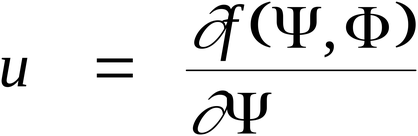
and
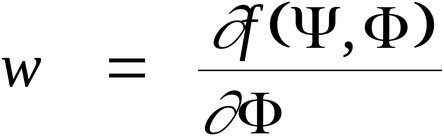
Then if we define a surface, or a higher dimensional hypersurface, by the elevations "z" such that "z" is continuous above and orthogonal to the dimensions of the (Ψ,Φ) hyperspace,

Then we can write the partial derivatives of z with respect to Ψ and Φ.
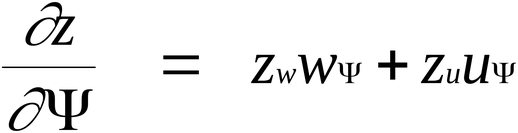
and
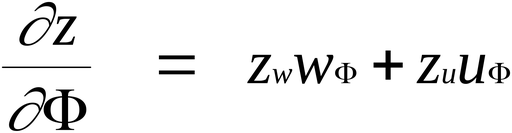
By measuring the slopes of the tangent planes to the hypersurfaces of Brain Activity Maps, it is possible to evaluate the partial derivatives of "z" with respect to Ψ and Φ, which are shown just above. Conducting these evaluations then gives us detailed information about the second partial derivatives of f(Ψ,Φ) with respect to Ψ and with respect to Φ. This is apparent when we expand the two preceding equations:

and

If we look back to the definitions of the functions "u" and "w", and do a partial substitution, into the two immediately preceding equations, we obtain:

and

This is not yet the base function f(Ψ,Φ), but here we have a useful way of learning about its second order partial derivatives. And if we note that we can also make measurements from the tangent planes to the Brain Activity Map hypersurfaces to derive the rates of change of the slopes of these tangent planes, then we can see that we have a means of evaluating the second order partial derivatives of "z". These are:

The equations for the second order partials of "z" with respect to Ψ and with respect to Φ, as well as the mixed partials can be written in the same manner as the derivations of the first order partials of "z". These equations involve the third order partial derivatives of f(Ψ,Φ), which gives us new information about the base function f(Ψ,Φ). The third order partial derivatives are expressed as follows:
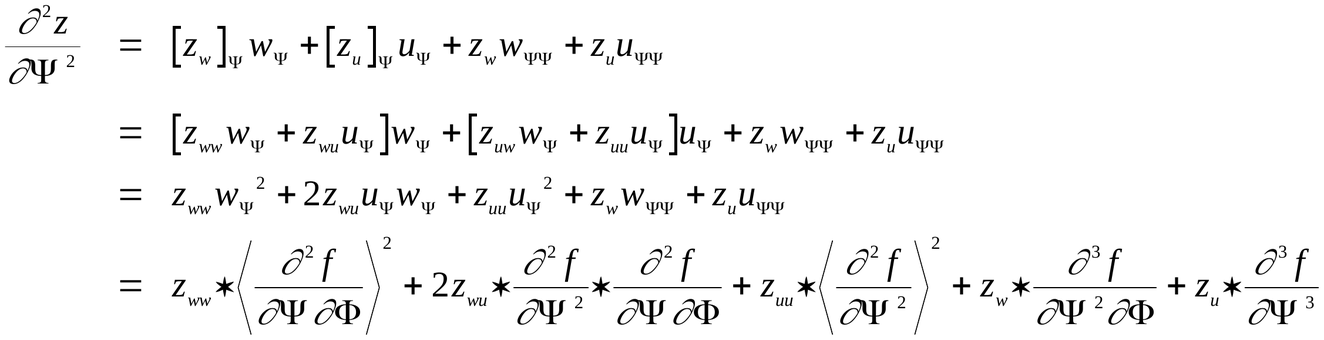
and
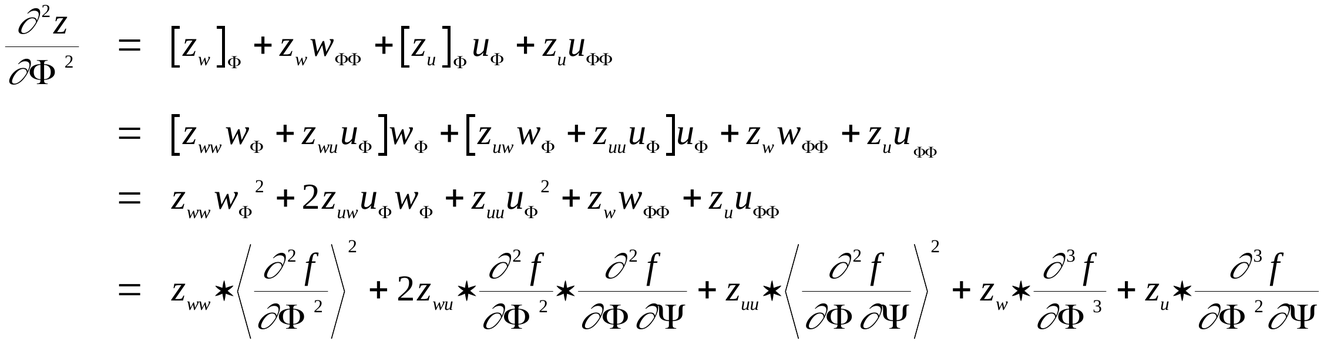
and
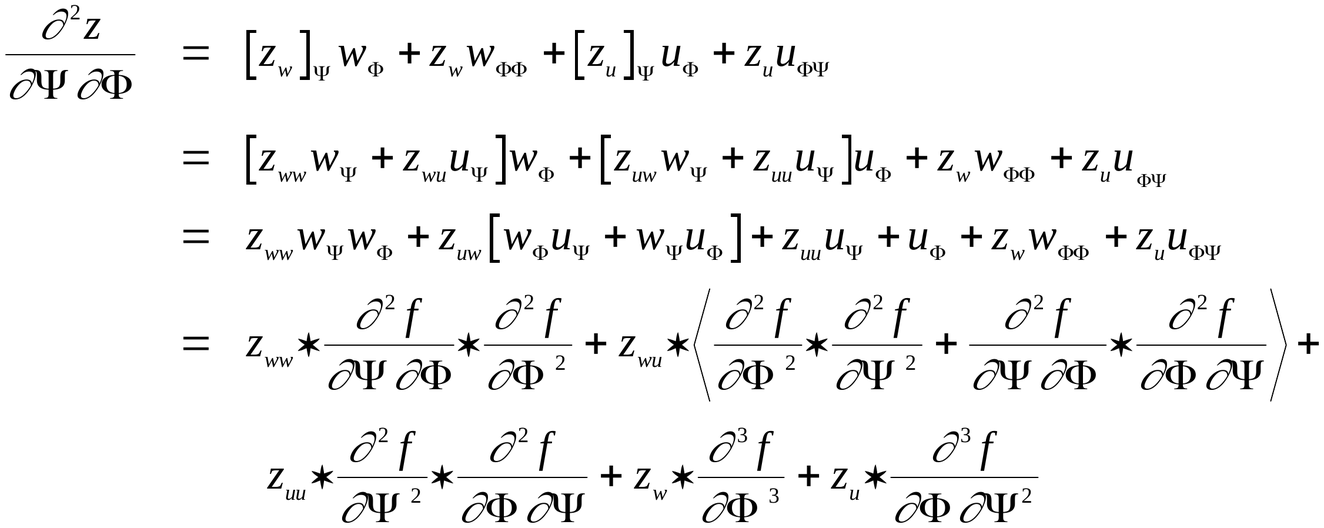
It is also possible to numerically evaluate, or approximate, the radius of curvature at any point on the Brain Activity Map hypersurfaces, which will aid us in evaluating some of the other terms in these equations, such as:

The numerical solutions to the second and the third order partial differential equations of f(Ψ,Φ) can be used to characterize the base function f(Ψ,Φ), the understanding of which is the central goal of Psychophysiology. The basic elements of this approach to the goal is to derive and to solve, numerically if necessary, the partial differential equations involving changes in psychological variables (Ψ) and changes in physiological variables (Φ). One approach is to produce parameterized families of equations, where the parameters can be associated with handedness and personality trait differences and to other factors which we already know lead to different families of partial differential hypersurfaces. Until f(Ψ,Φ) is fully characterized and the knowledge of f(Ψ,Φ) is complete, it is often more useful to have some incomplete knowledge of the partial derivatives of f(Ψ,Φ) than to have corresponding incomplete knowledge of the base function f(Ψ,Φ). For many uses such as learning applications, training applications, and therapy, it is actually more useful to have partial knowledge of the differential equations governing inter-related changes among Ψ and Φ variables, than to have partial knowledge of the static base function. In most applications we want to know how to change mood, attitudes, personality, performance, behavior, skills, and abilities. Making these useful changes is easy with the knowledge contained in the Differential Psychophysiological Surfaces of the Brain Activity Maps. These maps show exactly what patterns of brain activity to change in order to produce the desired outcome in changing attitudes, personality, performance, behavior, skills, and abilities.
Let us now look at some of these Brain Activity Maps and see how they are constructed. The live presentation of this work in Porto Carras featured more than a dozen overhead transparencies and more than 100 slides of Brain Activity Maps representing a variety of different mind states. This amount of graphic material is impractical in this current printed format, so only a few illustrative figures will be included. Figure 1 shows an early version of the Brain Activity Maps implemented without any smoothing. The x-axis is the frequency dimension of the EEG, and the y-axis is spatial location on the head. Figure 2 shows limited smoothing applied to a Brain Activity Map, in which the z-axis is the convolved relationship between changes in mind state and changes in brain state, with brain states defined by the position on the (x,y) grid plane, which is the (frequency, cortical location) grid plane. Figure 3 shows the fully smoothed Brain Activity Map for the mind state Anxiety, as indexed by the MAACL. Figure 4 shows how different EEG measures, such as Mean, Minimum, and Maximum EEG scores can be graphed separately or how they can be combined into a composite Brain Activity Map, which then highlights divergences between the different EEG measures in relationship to changes in the Anxiety surface. Usually a large positive convolved relationship between the changes in the Mean of an EEG variable and changes in the psychological variable will also mean a large positive convolved relationship between the changes in the Maximum of an EEG variable and changes in the psychological variable. When there is a divergence and this correspondence breaks down or even reverses, this is of great importance for any training method seeking to train changes in either the mind state or the brain state. The composite Brain Activity Maps highlight these divergences in a visually apparent manner suited to human pattern recognition abilities, which makes studying the Brain Activity Maps a much easier and faster process.
Figures 5-9 show different views of the Anxiety Brain Activity Maps, which aid in their study. Figure 5 shows the front and back views. Figure 6 shows the isometric projections of the front and back views. Figure 7 shows the inverse of the front and back views. Because the hidden line graphing technique hides the extent of the negative excursions, except in the front row, all of the z-elevations are multiplied by -1 to generate the inverse views, in which valleys become mountain ranges and vice versa. Figure 8 shows the isometric projections of the front and back inverse views. And finally, Figure 9 shows the 8 level contour map corresponding to the front view of the Anxiety Brain Activity Map. In the same way that all of Newtonian Physics fits within Einsteinian Relativity as a special case, so do all of our early Neurofeedback studies of anxiety reduction fit within the Anxiety Brain Activity Map. In those early studies we placed feedback electrodes mainly Occipitally, and trained for increases of EEG alpha activity. The more that Occipital alpha increased, the more anxiety was reduced, and conversely. This is exactly the result predicted by the deep valley shown at the center top of the contour map of Figure 9 [Occipital alpha region], and the back center section of the Brain Activity Maps shown in Figures 3 and 5. A valley means a negative relationship between the partial derivatives of EEG and anxiety. Increasing one term causes a decrease in the other. Thus anxiety can be reduced by increasing occipital alpha, and conversely. However, there are many other contributors to anxiety. The huge positive spike, outside of the Occipital region, and in the beta frequency range makes a greater contribution to anxiety changes than do changes in Occipital alpha. Training to reduce this spike, provided it is as easy to learn as Occipital alpha increases, could provide greater or more rapid anxiety reductions than are achieved by learning to increase Occipital alpha activity. And the wisest course of action is to train on the entire pattern simultaneously. The details of how to do this are beyond the scope of this paper, but they are central to the Neurofeedback programs of the Biocybernaut Institute. We usefully note here the optimistic result that Gary Schwartz has reported about learning physiological patterns. He found that learning an integrated physiological pattern with feedback techniques is easier than learning isolated pieces of the pattern.
In the course of showing more than 100 slides of different Brain Activity Maps, it became visually apparent that mind states we think of as similar have similar appearing topologies in the Brain Activity Maps. An example was the comparison between the maps for "Friendly" and "Vigor", which looked quite similar, except that alpha activity had to show increases in more regions of the head for the person to experience an increase of Friendliness, than for a similar magnitude increase in the experience of greater Vigor. Thus we can characterize "Friendly" as requiring more alpha-genesis than "Vigor", even though both "Friendly" and "Vigor" are positive high energy states. There were also some similar topological features in a whole family of negative mind states, including [from the MAACL] Anxiety, Anxiety of Commission, Anxiety of Omission, Depression, Depression of Commission, Depression of Omission, Hostility, Hostility of Commission, Hostility of Omission, and [from the POMS] Anger/Hostility, Depression/Dejection, and [from the Clyde Mood Scale] Unhappiness. These topological features were entirely lacking from numerous mind states, across a wide arousal range, which lacked the negativity of the prior list. Mind states lacking the topology of negativity included: [from the Clyde Mood Scale] Friendly, Aggressive, Sleepy, Dizzy, and [from the POMS] Confusion/Bewilderment, Fatigue, and Vigor. At first it was puzzling to discover the presence of "Aggressive" from the Clyde Mood Scale among the non-negative topologies, since aggression is usually viewed negatively. However, an item analysis of the Clyde's "Aggressive" scale revealed only items related to high energy. This scale was entirely lacking in items related to mean-spiritedness, or vindictiveness, or the desire to cause harm to self or others. "Energetic" or "Assertive" may be a better name for this "Aggressive" scale on the Clyde Mood Scale. Thus this "Aggressive" scale may actually be misnamed, a fact that was revealed by the topological comparisons of the Brain Activity Maps.
Those readers familiar with the above three mood scales may have noted that one scale has not yet been identified as to its topological association with the negative mind states or with the mind states failing to show the topological patterns shared among the negative mind states. The missing scale is "Clear Thinking" from the Clyde Mood Scale, and it was purposely omitted from both lists, because it is in a class by itself.
"Clear Thinking" shows the INVERSE of the topological pattern most closely identified with the negative mind states. Since it is impossible, topologically, to have a mountain and a valley in the same place, what this tells us is that someone cannot increase their degree of "Clear Thinking" without first decreasing each of the negative mind states: including [from the MAACL] Anxiety, Anxiety of Commission, Anxiety of Omission, Depression, Depression of Commission, Depression of Omission, Hostility, Hostility of Commission, Hostility of Omission, and [from the POMS] Anger/Hostility, Depression/Dejection, and [from the Clyde Mood Scale] Unhappiness. This simple truth is embedded in many ways in the spiritual wisdom of the world's great religions, and it may be that "Clear Thinking" is a gateway state to higher states of awareness. But if there is anger, or hostility, or fear or anxiety, or depression or unhappiness present in the mind, then there is no chance for an increase of clarity or "Clear Thinking" in that mind until these negative mind states shall have been diminished. The Brain Activity Maps show us a new way to conduct Neurofeedback training so that we can quickly and easily diminish anger, and hostility, fear and anxiety, depression and unhappiness. At the same time we have in the Differential Psychophysiological Surfaces of the Brain Activity Maps, an effective means for increasing our "Clear Thinking" and Happiness and Creativity. Let us go forth with this new state altering mind technology to transform ourselves and others, thereby creating through new Psychophysiological understanding of the information from the brain, the better world foreseen by Dr. Bechtereva. Thank you for your thoughtful attention.